

The Ticking Clock for Homebuyers
US Mortgage Rates 2026, The US housing market is tense right now. As of January 13, 2026, mortgage rates aren’t moving much. Many people who want to buy homes are stuck waiting to see what happens. People think the Federal Reserve will cut rates soon, but it looks like it’s getting harder to find affordable homes. In finance, waiting for the perfect time can cost you more than you save on interest.
(Knowing your score is the first step toward securing a competitive mortgage rate)
The Reality of “High” Rates in 2026
We often look back at the days of 3% or 4% interest rates. But we need to realize those rates were unusual and not the norm. Now, rates between 6.5% and 7.2% seem to be the New Normal. Even though many people are searching for mortgage interest rates, they might not see how these rates are linked to changes in banks. For example, big banks like Chase are greatly changing their physical locations. This shows a larger shift in how financial services get to people.
This uncertainty is partly due to how banks are evolving. Read our deep dive: Chase Bank Branch Closures: What it means for you.
Connecting the Dots: Why Rates Aren’t Dropping
You may be wondering why rates are still high, even though inflation has gone down in some areas. This is because the bond market is strong and the US job market is doing better than expected. As long as a lot of people are working, the Federal Reserve doesn’t think it needs to lower rates quickly to help the economy. This has caused a situation where homeowners don’t want to sell because they have low rates, which means there aren’t many homes for sale. Because there are fewer homes available, prices stay high even when it costs a lot to borrow money. (US Mortgage Rates 2026)
Expert Opinion: The Sanford Kuhn Analysis
As a journalist, I’ve noticed something most home buyers overlook: we’re in a Sideways Market right now. Home prices aren’t going way up or down. This is a good chance for many people. If you wait for interest rates to drop to 5%, many buyers who have been waiting will probably jump into the market, which could push home prices up by 10% or more. So, the money you save on interest could be lost because you’d be paying more for the house.
The Hidden Cost of Waiting
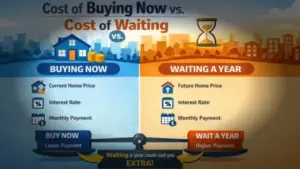
Let’s look at the math. If you buy a place now and rates go down next year, you can refinance. But if you wait and prices go up, you miss out on the chance to refinance at today’s price. It’s better to start building equity now than to gamble on what the market might do later. This link between cost and timing is key to smart money management. (US Mortgage Rates 2026)
Before entering the market, ensure your financial profile is ready. Read: How to build credit fast in 2026
Credit Score: Your Only Leverage
In the current environment, a good credit score is your strongest tool. It’s tougher to get a loan these days, so having a credit score of 760 might get you a 6.7% rate, while a score of 660 could mean paying 7.5%. Over 30 years, that small difference really adds up. Your credit score is one thing about buying a house that you can totally control.
(Use our professional tools to optimize your credit profile and qualify for premium rates)
Active Market Analysis: Broader Economic Signals
Big market companies, like JPM and Google, are reacting to these interest rate signs. High rates help banks make more money, but they also make it more expensive to borrow money for new tech. This affects things like your 401k, savings accounts, and credit card debt. Everything in today’s economy is linked, so watching mortgage trends is important if you want to stay financially healthy in 2026. (US Mortgage Rates 2026)
Conclusion: Stop Guessing, Start Planning
Instead of trying to guess what the Federal Reserve will do next, concentrate on what you can control. Work on your debt-to-income ratio and strengthen your savings plan. The housing market in 2026 will favor those who are ready, not just wishful thinkers. If you listen to the experts, using confirmed info to build trust is the smartest way to handle these shaky financial times. (US Mortgage Rates 2026)
Frequently Asked Questions (FAQs)
1. Is 2026 a good year to buy a home in the US?
Yes, so it looks like 2026 could be a good year for real estate. The crazy low prices might be over, but the market’s becoming more stable. There are more houses available in some states, and prices aren’t increasing as fast, which means buyers have a stronger position to make deals. Still, experts say that if you’re buying this year, be prepared to keep the property for at least 5 to 10 years. That way, you can get through any ups and downs and build equity.
2. Will mortgage rates ever return to 3%?
Realistically speaking, don’t count on seeing mortgage rates go back down to 3% anytime soon. Those super-low rates were just a temporary fix during a major world economic crisis and not something we usually see. As the Federal Reserve gets things back on track, we’re heading into a new normal. For 2026 and later, a 30-year fixed mortgage will probably be between 5.5% and 6.5%. Buyers should plan their finances with these numbers in mind instead of waiting for those 3% rates to return because they likely won’t.
3. How much does a 1% rate increase change a monthly payment?
A 1% difference might not seem like a lot, but it can really add up over time with debt. For instance, on a $300,000 mortgage, a 1% jump in the interest rate usually means you’ll pay around $200 to $250 more each month on your principal and interest. And over 30 years, that small change could end up costing you an extra $70,000 to $90,000 in interest. That’s why it’s so important to shop around for the best rate and work on your credit score before you sign anything.
4. What is the ideal credit score for the best mortgage rates?
Having a credit score of 740 or higher can help you get the best mortgage rates. Lenders consider this score Excellent, meaning they see you as less of a risk and will offer you lower interest rates. Even though you might get approved with a score between 620 and 700, you’ll probably pay a lot more interest over the life of the loan. Boosting your score by just 20 points before you apply could save you big money.